Showing posts with label NGS. Show all posts

Tuesday, 28 September 2021

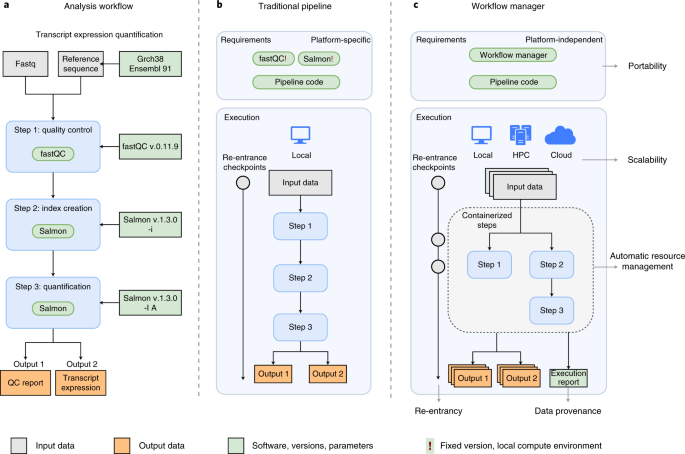
Reproducible, scalable, and shareable analysis pipelines with bioinformatics workflow managers | Nature Methods

 Reproducible, scalable, and shareable analysis pipelines with bioinformatics workflow managers | Nature Methods 


https://github.com/GoekeLab/bioinformatics-workflows    


Friday, 17 September 2021

Benchmarking variants and comparing truth sets: List of useful tools and publications

Just realised that other than vcf-compare and bedtools intersect 

there's other options


https://github.com/RealTimeGenomics/rtg-tools

https://github.com/Illumina/hap.py


Also there's actually new variant callers ..

Molina-Mora, J.A., Solano-Vargas, M. Set-theory based benchmarking of three different variant callers for targeted sequencing. BMC Bioinformatics 22, 20 (2021). https://doi.org/10.1186/s12859-020-03926-3


Krishnan, V., Utiramerur, S., Ng, Z. et al. Benchmarking workflows to assess performance and suitability of germline variant calling pipelines in clinical diagnostic assays. BMC Bioinformatics 22, 85 (2021). https://doi.org/10.1186/s12859-020-03934-3

Additional file 23: File 3

. verify_variants.py


Zook, Justin M et al. “An open resource for accurately benchmarking small variant and reference calls.” Nature biotechnology vol. 37,5 (2019): 561-566. doi:10.1038/s41587-019-0074-6


Python library to parse, format, validate, normalize, and map sequence variants. `pip install hgvs`


Thursday, 12 November 2020

A novel BRCA2 splice variant identified in a young woman

 Sharing a newly published article where a novel c.682‐2delA variant involving the AG consensus at the 3′ end of BRCA2 intron 8 was detected. The case involved a 33‐year‐old Italian breast cancer patient belonging to a HBOC family (BRCAPro score: 88%) with no other known pathogenic BRCA mutation. 


A novel BRCA2 splice variant identified in a young woman - Nicolussi - - Molecular Genetics & Genomic Medicine

Wednesday, 4 November 2020

de novo assembly of Ion Torrent Reads

 I am intrigued that this Genome assembly guide includes mention of SOLID and Ion Torrent ... although not much information is given on how to work on them for genome assembly. 

That said, perhaps the SPADES plugin provided with the sequencer solves most of everyone's immediate needs ... Wondering how improve on evaluating the assemblies 


Wednesday, 2 March 2016

Baylor releases Exome and WGS data of 7 cancer patients with Open Access

An open access pilot freely sharing cancer genomic data from participants in Texas
  • Scientific Data 3, Article number: 160010 (2016) 
  • ​doi:10.1038/sdata.2016.10
  •  In a pilot Open Access (OA) project from the CPRIT-funded Texas Cancer Research Biobank, many Texas cancer patients were willing to openly share genomic data from tumor and normal matched pair specimens. For the first time, genetic data from 7 human cancer cases with matched normal are freely available without requirement for data use agreements nor any major restriction except that end users cannot attempt to re-identify the participants (http://txcrb.org/open.html).

There's whole exome seq data and 2 whole genome sequencing data where the sample quality is good enough for WGS.
A copy of the open-access TCRB data, conditions of use, and the HGSC’s Mercury informatics pipeline is available now for DNAnexus Platform users.

The full paper is here http://www.nature.com/articles/sdata201610
A copy of the data is also available for DNAnexus Platform users here https://dnanexus.github.io/tcrb-data/


Tuesday, 28 January 2014

Growth slows in cloud business

Has the cloud hype died down? Seagate reportedly misses analyst's estimates as growth slowed in it's cloud storage business. With the exception of Galaxy or Basespace, it's hard to get researchers to buy into the cloud analysis paradigm even though their sporadic usage pattern would fit nicely for the economics of cloud usage. Maybe the cost of storage space / moving files into the cloud is the biggest hurdle.  My two cents.


Wednesday, 2 October 2013

Biome | Q&A with Rich Roberts on single-molecule sequencing technology

The exciting part about single molecule sequencing for me was the ability to sequence low abundance transcripts or have phased haplotypes for human sequencing. Having a high error rate nullifies any advantage in these areas. But I guess it's a tool in the end and how you use it to get meaning results.


"As the previously rapid climb in cost efficiency brought about by next-generation sequencing plateaus, the failure of single-molecule sequencing to deliver might leave some genomics aficionados despondent about the prospects for their field. But a recentCorrespondence article in Genome Biology saw Nobel laureate Richard Roberts, together with Cold Spring Harbor’s Mike Schatz and Mauricio Carneiro of the Broad Institute, argue that the latest iteration of Pacific Biosciences’ SMRT platform is a powerful tool, whose value should be reassessed by a skeptical community.
In this Q&A, Roberts tells us why he thinks there’s a need for re-evaluation, and what sparked his interest in genomics in the first place."

http://www.biomedcentral.com/biome/rich-roberts-discusses-single-molecule-sequencing-technology/


Correspondence
Article has an altmetric score of 55

The advantages of SMRT sequencing

Roberts RJ, Carneiro MO and Schatz MC
Genome Biology 2013, 14:405

Go to article >>

Wednesday, 24 July 2013

Illumina produces 3k of 8500 bp reads on HiSeq using Moleculo Technology

Keith blogged about how super long read sequencing methods would be a threat to Illumina in Jan 2013. Today, Illumina can now openly acknowledge the shortcomings of their short reads for various applications like
  • assembly of complex genomes (polyploid, containing excessive long repeat regions, etc.), 
  • accurate transcript assembly, 
  • metagenomics of complex communities, 
  • and phasing of long haplotype blocks.


the reason?
This latest set of data released on BaseSpace
Read length distribution of synthetic long reads for a D. melanogaster library
The data set, available as a single project in BaseSpace, can be accessed here.

image source: http://blog.basespace.illumina.com/2013/07/22/first-data-set-from-fasttrack-long-reads-early-access-service/

with the integration of Moleculo they have managed to generate ~30 gb of raw sequence data. They have refrained from talking about 'key analysis metrics' that's available in the pdf report. Perhaps it's much easier to let the blogosphere and data scientists dissect the new data themselves.

Am wondering when the 454 versus Illumina Long Reads side-by-side comparison will pop up

UPDATE:

Can't find the 'key analysis metrics' in the pdf report files. Perhaps it's still being uploaded? *shrugs*
so please update me if you see it  otherwise I just have to run something on it


These are the files that I have now

total 512M
 259M Jul 18 01:01 mol-32-2832.fastq.gz
  44K Jul 24  2013 FastTrackLongReads_dmelanogaster_281c.pdf
 149K Jul 24  2013 mol-32-281c-scaffolds.txt
  44K Jul 24  2013 FastTrackLongReads_dmelanogaster_2832.pdf
 151K Jul 24  2013 mol-32-2832-scaffolds.txt
 253M Jul 24  2013 mol-32-281c.fastq.gz

md5sums
6845fc3a4da9f93efc3a52f288e2d7a0  FastTrackLongReads_dmelanogaster_281c.pdf
02f5de4f7e15bbcd96ada6e78f659fdb  FastTrackLongReads_dmelanogaster_2832.pdf
586599bb7fca3c20ba82a82921e8ba3f  mol-32-281c-scaffolds.txt
b25010e9e5e13dc7befc43b5dff8c3d6  mol-32-281c.fastq.gz
6822cfbd3eb2a535a38a5022c1d3c336  mol-32-2832-scaffolds.txt
873f09080cdf59ed37b3676cddcbe26f  mol-32-2832.fastq.gz


I have ran FastQC (FastQC v0.10.1) on both samples the images below are from 281c.
you can download the full HTML report here
https://www.dropbox.com/sh/5unu3zba9u21ywj/JT4HdkzfOP/mol-32-281c_fastqc.zip
https://www.dropbox.com/s/mpxa5wx51iqmiz3/mol-32-2832_fastqc.zip

Reading about the Moleculo sample prep method, it seems like it's just a rather ingenious way to stitch short reads which are barcoded to form a single long contig. if that is the case, then I am not sure if the base quality scores here are meaningful anymore since it's a mini-assembly. Also this takes out any quantitative value of the number of reads I presume. So accurate quantification of long RNA molecules or splice variants isn't possible. Nevertheless it's an interesting development on the Illumina platform. Looking forward to seeing more news about it.


Other links

Illumina Long-Read Sequencing Service
Moleculo technology: synthetic long reads for genome phasing, de novo sequencing
CoreGenomics: Genome partitioning: my moleculo-esque idea
Moleculo and Haplotype Phasing - The Next Generation TechnologistNext Generation Technologist
Abstract: Production Of Long (1.5kb – 15.0kb), Accurate, DNA Sequencing Reads Using An Illumina HiSeq2000 To Support De Novo Assembly Of The Blue Catfish Genome (Plant and Animal Genome XXI Conference)
http://www.moleculo.com/ (no info on this page though)
Illumina Announces Phasing Analysis Service for Human Whole-Genome Sequencing - MarketWatch
Patent information on the Long Read technology
https://docs.google.com/viewer?url=patentimages.storage.googleapis.com/pdfs/US20130079231.pdf


Friday, 28 June 2013

Lessons learned from implementing a national infrastructure in Sweden for storage and analysis of next-generation sequencing data

Each time when I change jobs, I will have to go through the adventure (and sometimes pain) to relearn about the computing resources available to me (personal), lab (small sharing pool), and the entire institute/company/school (Not enought to go around usually).
Depending on the job scope / number of cores / length of the job I would then setup the computing resources to run on either of the 3 resources available to me.
Sometimes, grant money appears magically and I am asked by my boss what do I need to buy (ok TBH  this is rare). Hence it's always nice to keep a lookout on what's available on the market and who's using what to do what. So that one day when grant money magically appears, I won't be stumped for an answer.

excerpted from the provisional PDF are three points which I agree fully

Three GiB of RAM per core is not enough
you won't believe the number of things I tried to do to outsmart the 'system' just to squeeze enough ram for my jobs. Like looking for parallel queues which often have a bigger amount of RAM allocation. Doing tests for small jobs to make sure it runs ok before scaling it up and have it fail after two days due to insufficient RAM.
MPI is not widely used in NGS analysis
A lot of the queues in the university shared resource has ample resources for my jobs but were reserved for MPI jobs. Hence I can't touch those at all.
A central file system helps keep redundancy to a minimum
balancing RAM / compute cores to make the job splitting efficient was one thing. The other pain in the aXX was having to move files out of the compute node as soon as the job is done and clear all intermediate files. There were times where the job might have failed but as I deleted the intermediate files in the last step of the pipeline bash script, I wasn't able to be sure it ran to completion. In the end I had to rerun the job and keeping the intermediate files


anyway for more info you can check out the below

http://www.gigasciencejournal.com/content/2/1/9/abstract

Lessons learned from implementing a national infrastructure in Sweden for storage and analysis of next-generation sequencing data

Samuel Lampa, Martin Dahlö, Pall I Olason, Jonas Hagberg and Ola Spjuth
For all author emails, please log on.
GigaScience 2013, 2:9 doi:10.1186/2047-217X-2-9
Published: 25 June 2013

Abstract (provisional)

Analyzing and storing data and results from next-generation sequencing (NGS) experiments is a challenging task, hampered by ever-increasing data volumes and frequent updates of analysis methods and tools. Storage and computation have grown beyond the capacity of personal computers and there is a need for suitable e-infrastructures for processing. Here we describe UPPNEX, an implementation of such an infrastructure, tailored to the needs of data storage and analysis of NGS data in Sweden serving various labs and multiple instruments from the major sequencing technology platforms. UPPNEX comprises resources for high-performance computing, large-scale and high-availability storage, an extensive bioinformatics software suite, up-to-date reference genomes and annotations, a support function with system and application experts as well as a web portal and support ticket system. UPPNEX applications are numerous and diverse, and include whole genome-, de novo- and exome sequencing, targeted resequencing, SNP discovery, RNASeq, and methylation analysis. There are over 300 projects that utilize UPPNEX and include large undertakings such as the sequencing of the flycatcher and Norwegian spruce. We describe the strategic decisions made when investing in hardware, setting up maintenance and support, allocating resources, and illustrate major challenges such as managing data growth. We conclude with summarizing our experiences and observations with UPPNEX to date, providing insights into the successful and less successful decisions made.

The complete article is available as a provisional PDF. The fully formatted PDF and HTML versions are in production.

Wednesday, 5 September 2012

[pub] SEED: efficient clustering of next-generation sequences.


 2011 Sep 15;27(18):2502-9. Epub 2011 Aug 2.

SEED: efficient clustering of next-generation sequences.

Source

Department of Computer Science and Engineering, University of California, Riverside, CA 92521, USA.

Abstract

MOTIVATION:

Similarity clustering of next-generation sequences (NGS) is an important computational problem to study the population sizes of DNA/RNA molecules and to reduce the redundancies in NGS data. Currently, most sequence clustering algorithms are limited by their speed and scalability, and thus cannot handle data with tens of millions of reads.

RESULTS:

Here, we introduce SEED-an efficient algorithm for clustering very large NGS sets. It joins sequences into clusters that can differ by up to three mismatches and three overhanging residues from their virtual center. It is based on a modified spaced seed method, called block spaced seeds. Its clustering component operates on the hash tables by first identifying virtual center sequences and then finding all their neighboring sequences that meet the similarity parameters. SEED can cluster 100 million short read sequences in <4 10-fold="10-fold" 12-27="12-27" 2-="2-" 21-41="21-41" 60-85="60-85" a="a" able="able" addition="addition" also="also" and="and" area="area" as="as" asis="asis" assembler="assembler" assemblies="assemblies" assembly="assembly" best="best" better="better" by="by" cluster="cluster" clustering="clustering" clusters="clusters" compared="compared" contained="contained" contigs="contigs" data="data" datasets="datasets" demonstrate="demonstrate" discovering="discovering" efficiency="efficiency" fall="fall" for="for" from="from" generating="generating" genome="genome" h="h" in="in" indicated="indicated" into="into" it="it" its="its" larger="larger" linear="linear" longer="longer" memory="memory" most="most" n50="n50" ngs="ngs" non-preprocessed="non-preprocessed" of="of" on="on" organisms.="organisms." other="other" our="our" p="p" performance.="performance." performance="performance" preprocessing="preprocessing" reduce="reduce" requirements="requirements" respectively.="respectively." results="results" rna="rna" s="s" seed="seed" sequences="sequences" showed="showed" similar="similar" small="small" stand-alone="stand-alone" study="study" tests="tests" than="than" the="the" this="this" time="time" to="to" tool="tool" tools="tools" transcriptome="transcriptome" true="true" unsequenced="unsequenced" used="used" using="using" utilities="utilities" values.="values." velvet="velvet" was="was" when="when" while="while" with="with">

AVAILABILITY:

The SEED software can be downloaded for free from this site: http://manuals.bioinformatics.ucr.edu/home/seed.

CONTACT:

thomas.girke@ucr.edu

SUPPLEMENTARY INFORMATION:

Supplementary data are available at Bioinformatics online.
PMID:
 
21810899
 
[PubMed - indexed for MEDLINE] 
PMCID:
 
PMC3167058
 
Free PMC Article
Icon for HighWire Press Icon for PubMed Central

Tuesday, 15 May 2012

NATURE BIOTECHNOLOGY | Performance comparison of benchtop high-throughput sequencing platforms


Performance comparison of benchtop high-throughput sequencing platforms

Nature Biotechnology
 
30,
 
434–439
 
(2012)
 
doi:10.1038/nbt.2198
Received
 
Accepted
 
Published online
 
Corrected online
 

Abstract

Three benchtop high-throughput sequencing instruments are now available. The 454 GS Junior (Roche), MiSeq (Illumina) and Ion Torrent PGM (Life Technologies) are laser-printer sized and offer modest set-up and running costs. Each instrument can generate data required for a draft bacterial genome sequence in days, making them attractive for identifying and characterizing pathogens in the clinical setting. We compared the performance of these instruments by sequencing an isolate of Escherichia coli O104:H4, which caused an outbreak of food poisoning in Germany in 2011. The MiSeq had the highest throughput per run (1.6 Gb/run, 60 Mb/h) and lowest error rates. The 454 GS Junior generated the longest reads (up to 600 bases) and most contiguous assemblies but had the lowest throughput (70 Mb/run, 9 Mb/h). Run in 100-bp mode, the Ion Torrent PGM had the highest throughput (80–100 Mb/h). Unlike the MiSeq, the Ion Torrent PGM and 454 GS Junior both produced homopolymer-associated indel errors (1.5 and 0.38 errors per 100 bases, respectively).

Figures at a glance

Datanami, Woe be me