
Wednesday, 13 November 2013


Consumer Grade HDD are OK for Data backup
Ah storage, who doesn't need more of it? Cheaply I might add.
The folks at Backblaze published their own field report on HDD failure rate which is interesting for any data center.
Earlier I had read about Google's study on how temperature doesn't affect HDD failure rate and promptly removed the noisy HDD cooling fans in my Linux box.
Their latest blog post at http://blog.backblaze.com/2013/11/12/how-long-do-disk-drives-last/ has me thinking that some of my colleagues elsewhere that are doing Backblaze like setups should switch to consumer grade HDDs to save on cost.
I do have a 80 Gb Seagate HDD that has survived the years. Admittedly I am not sure what to do with it anymore as it is too small(80 Gb) to be useful and too big (3.5") to be portable. It was used as a main HDD until it's size rendered it obselete hence it's sitting in a USB HDD dock that I use occasionally.
maybe you can find out the age by looking up the serial number but I use the SMART data info that you can see from the Disk Utility in Ubuntu.
However the age as you can see from the screen shot is an estimate of the days it has been powered on.
Hmm pretty low mileage for a 80 Gb HDD eh?
Check out this 320 Gb IDE HDD
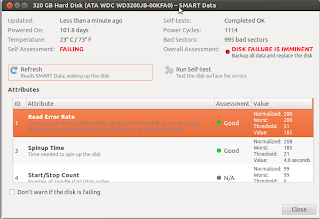
Even lower mileage! Not too sure of the history of this drive so can't really comment here.
Completely anecdotal but I have 3 Seagate 1 Tb HDD dying within a year from a software 5x HDD RAID array from within CentOS. When I checked on the powered on days it says it has been running for 3 years. So I am
1) confused how SMART data records HDD age
2) in agreement with Backblaze that HDD have specific failure phases. (where usage patterns play less of a role perhaps)
3)guessing that most of the data on Backblaze are archival in nature i.e. write once and forget until disaster strikes. So it would be great if Backblaze can 'normalize' the lifespan of the HDD with data access patterns per HDD to make it more relevant for a crowd that has a slightly different usage pattern than pure data archival needs.
That said I think it's an excellent piece of reading if you are concerned about using consumer grade HDD. Kudos the Backblaze team who managed to 'shuck' 5.5 Petabytes of raw HDD to weather the Thailand crisis (wonder how that affected their economics of using consumer grade HDD)
As usual YMMV applies here. Feel free to use consumer grade HDD for your archival needs but be sure to build in redundancy and resilience into your system like the folks in Backblaze.
The folks at Backblaze published their own field report on HDD failure rate which is interesting for any data center.
Earlier I had read about Google's study on how temperature doesn't affect HDD failure rate and promptly removed the noisy HDD cooling fans in my Linux box.
Their latest blog post at http://blog.backblaze.com/2013/11/12/how-long-do-disk-drives-last/ has me thinking that some of my colleagues elsewhere that are doing Backblaze like setups should switch to consumer grade HDDs to save on cost.
I do have a 80 Gb Seagate HDD that has survived the years. Admittedly I am not sure what to do with it anymore as it is too small(80 Gb) to be useful and too big (3.5") to be portable. It was used as a main HDD until it's size rendered it obselete hence it's sitting in a USB HDD dock that I use occasionally.
maybe you can find out the age by looking up the serial number but I use the SMART data info that you can see from the Disk Utility in Ubuntu.
 |
| My ancient 3.5" HDD |
 |
| Powered on only for 314 days! |
Hmm pretty low mileage for a 80 Gb HDD eh?
Check out this 320 Gb IDE HDD

Completely anecdotal but I have 3 Seagate 1 Tb HDD dying within a year from a software 5x HDD RAID array from within CentOS. When I checked on the powered on days it says it has been running for 3 years. So I am
1) confused how SMART data records HDD age
2) in agreement with Backblaze that HDD have specific failure phases. (where usage patterns play less of a role perhaps)
3)guessing that most of the data on Backblaze are archival in nature i.e. write once and forget until disaster strikes. So it would be great if Backblaze can 'normalize' the lifespan of the HDD with data access patterns per HDD to make it more relevant for a crowd that has a slightly different usage pattern than pure data archival needs.
That said I think it's an excellent piece of reading if you are concerned about using consumer grade HDD. Kudos the Backblaze team who managed to 'shuck' 5.5 Petabytes of raw HDD to weather the Thailand crisis (wonder how that affected their economics of using consumer grade HDD)
As usual YMMV applies here. Feel free to use consumer grade HDD for your archival needs but be sure to build in redundancy and resilience into your system like the folks in Backblaze.
Monday, 28 October 2013
Illumina Webinar Series: Sequencing Difficult Templates - Why Quality is Everything
Sequencing Difficult Templates - Why Quality is Everything
Date:
Wednesday, November 6
Register Now
Time: 1:00 pm A.E.D.T
Speaker:
Josquin Tibbits, PhD,
Senior Research Scientist, Dept of Environment and Primary Industries
Abstract
For most applications, sequence quality (low error rates, correct library size, even coverage etc), stands out as the key metric for the downstream utility of data from NGS platforms. I investigate the quality and utility of data generated from a range of platforms (454, HiSeq, MiSeq and PGM) for the reference initiated assembly of homopolymer, repeat and low complexity plant plastid genomes. These types of sequences are a good proxy for the more difficult sequence regions found when exploring larger genomes in both agricultural and human sequencing projects. The analysis will show in detail how the different platforms cope with these challenging regions
Wednesday, 2 October 2013
Biome | Q&A with Rich Roberts on single-molecule sequencing technology
The exciting part about single molecule sequencing for me was the ability to sequence low abundance transcripts or have phased haplotypes for human sequencing. Having a high error rate nullifies any advantage in these areas. But I guess it's a tool in the end and how you use it to get meaning results.
"As the previously rapid climb in cost efficiency brought about by next-generation sequencing plateaus, the failure of single-molecule sequencing to deliver might leave some genomics aficionados despondent about the prospects for their field. But a recentCorrespondence article in Genome Biology saw Nobel laureate Richard Roberts, together with Cold Spring Harbor’s Mike Schatz and Mauricio Carneiro of the Broad Institute, argue that the latest iteration of Pacific Biosciences’ SMRT platform is a powerful tool, whose value should be reassessed by a skeptical community.
http://www.biomedcentral.com/biome/rich-roberts-discusses-single-molecule-sequencing-technology/

 Go to article >>
"As the previously rapid climb in cost efficiency brought about by next-generation sequencing plateaus, the failure of single-molecule sequencing to deliver might leave some genomics aficionados despondent about the prospects for their field. But a recentCorrespondence article in Genome Biology saw Nobel laureate Richard Roberts, together with Cold Spring Harbor’s Mike Schatz and Mauricio Carneiro of the Broad Institute, argue that the latest iteration of Pacific Biosciences’ SMRT platform is a powerful tool, whose value should be reassessed by a skeptical community.
In this Q&A, Roberts tells us why he thinks there’s a need for re-evaluation, and what sparked his interest in genomics in the first place."
http://www.biomedcentral.com/biome/rich-roberts-discusses-single-molecule-sequencing-technology/
Correspondence
The advantages of SMRT sequencing
Genome Biology 2013, 14:405
Go to article >>
Wednesday, 28 August 2013
Case-Based Introduction to Biostatistics with Scott Zeger
For those that might be keen this course is on Coursera
https://www.coursera.org/course/casebasedbiostat
https://www.coursera.org/course/casebasedbiostat
About the Course
The course objective is to enable each student to enhance his or her quantitative scientific reasoning about problems related to human health. Biostatistics is about quantitative approaches - ideas and skills - to address bioscience and health problems. To achieve mastery of biostatistics skills, a student must “see one, do one, teach one.” Therefore, the course is organized to promote regular practice of new ideas and methods.
The course is organized into 3 self-contained modules. Each module except the first is built around an important health problem. The first module reviews the scientific method and the role of experimentation and observation to generate data, or evidence, relevant to selecting among competing hypotheses about the natural world. Bayes theorem is used to quantify the concept of evidence. Then, we will discuss what is meant by the notion of “cause.”
In the second module, we use a national survey dataset to estimate the costs of smoking and smoking-caused disease in American society. The concepts of point and interval estimation are introduced. Students will master the use of confidence intervals to draw inferences about population means and differences of means. They will use stratification and weighted averages to compare subgroups that are otherwise similar in an attempt to estimate the effects of smoking and smoking-caused diseases on medical expenditures.
In the final module, we will study what factors influence child-survival in Nepal using data from the Nepal Nutritional Intervention Study Sarlahi or NNIPPS. Students will estimate and obtain confidence intervals for infant survival rates, relative rates and odds ratios within strata defined by gestational period, singleton vs twin births, and parental characteristics.
The course is organized into 3 self-contained modules. Each module except the first is built around an important health problem. The first module reviews the scientific method and the role of experimentation and observation to generate data, or evidence, relevant to selecting among competing hypotheses about the natural world. Bayes theorem is used to quantify the concept of evidence. Then, we will discuss what is meant by the notion of “cause.”
In the second module, we use a national survey dataset to estimate the costs of smoking and smoking-caused disease in American society. The concepts of point and interval estimation are introduced. Students will master the use of confidence intervals to draw inferences about population means and differences of means. They will use stratification and weighted averages to compare subgroups that are otherwise similar in an attempt to estimate the effects of smoking and smoking-caused diseases on medical expenditures.
In the final module, we will study what factors influence child-survival in Nepal using data from the Nepal Nutritional Intervention Study Sarlahi or NNIPPS. Students will estimate and obtain confidence intervals for infant survival rates, relative rates and odds ratios within strata defined by gestational period, singleton vs twin births, and parental characteristics.
Recommended Background
Interest in the scientific method as broadly related to human health. Ability to reason precisely. Mathematics through pre-calculus.
Suggested Readings
The Mismeasure of Man by Stephen J. Gould is an outstanding resource, but it is not a required text for this course.
Wednesday, 24 July 2013
Illumina produces 3k of 8500 bp reads on HiSeq using Moleculo Technology
Keith blogged about how super long read sequencing methods would be a threat to Illumina in Jan 2013. Today, Illumina can now openly acknowledge the shortcomings of their short reads for various applications like
the reason?
This latest set of data released on BaseSpace
image source: http://blog.basespace.illumina.com/2013/07/22/first-data-set-from-fasttrack-long-reads-early-access-service/
with the integration of Moleculo they have managed to generate ~30 gb of raw sequence data. They have refrained from talking about 'key analysis metrics' that's available in the pdf report. Perhaps it's much easier to let the blogosphere and data scientists dissect the new data themselves.
Am wondering when the 454 versus Illumina Long Reads side-by-side comparison will pop up
so please update me if you see it otherwise I just have to run something on it

These are the files that I have now
total 512M
259M Jul 18 01:01 mol-32-2832.fastq.gz
44K Jul 24 2013 FastTrackLongReads_dmelanogaster_281c.pdf
149K Jul 24 2013 mol-32-281c-scaffolds.txt
44K Jul 24 2013 FastTrackLongReads_dmelanogaster_2832.pdf
151K Jul 24 2013 mol-32-2832-scaffolds.txt
253M Jul 24 2013 mol-32-281c.fastq.gz
md5sums
6845fc3a4da9f93efc3a52f288e2d7a0 FastTrackLongReads_dmelanogaster_281c.pdf
02f5de4f7e15bbcd96ada6e78f659fdb FastTrackLongReads_dmelanogaster_2832.pdf
586599bb7fca3c20ba82a82921e8ba3f mol-32-281c-scaffolds.txt
b25010e9e5e13dc7befc43b5dff8c3d6 mol-32-281c.fastq.gz
6822cfbd3eb2a535a38a5022c1d3c336 mol-32-2832-scaffolds.txt
873f09080cdf59ed37b3676cddcbe26f mol-32-2832.fastq.gz
I have ran FastQC (FastQC v0.10.1) on both samples the images below are from 281c.
you can download the full HTML report here
https://www.dropbox.com/sh/5unu3zba9u21ywj/JT4HdkzfOP/mol-32-281c_fastqc.zip
https://www.dropbox.com/s/mpxa5wx51iqmiz3/mol-32-2832_fastqc.zip
Reading about the Moleculo sample prep method, it seems like it's just a rather ingenious way to stitch short reads which are barcoded to form a single long contig. if that is the case, then I am not sure if the base quality scores here are meaningful anymore since it's a mini-assembly. Also this takes out any quantitative value of the number of reads I presume. So accurate quantification of long RNA molecules or splice variants isn't possible. Nevertheless it's an interesting development on the Illumina platform. Looking forward to seeing more news about it.


Moleculo technology: synthetic long reads for genome phasing, de novo sequencing
CoreGenomics: Genome partitioning: my moleculo-esque idea
Moleculo and Haplotype Phasing - The Next Generation TechnologistNext Generation Technologist
Abstract: Production Of Long (1.5kb – 15.0kb), Accurate, DNA Sequencing Reads Using An Illumina HiSeq2000 To Support De Novo Assembly Of The Blue Catfish Genome (Plant and Animal Genome XXI Conference)
http://www.moleculo.com/ (no info on this page though)
Illumina Announces Phasing Analysis Service for Human Whole-Genome Sequencing - MarketWatch
https://docs.google.com/viewer?url=patentimages.storage.googleapis.com/pdfs/US20130079231.pdf
- assembly of complex genomes (polyploid, containing excessive long repeat regions, etc.),
- accurate transcript assembly,
- metagenomics of complex communities,
- and phasing of long haplotype blocks.
the reason?
This latest set of data released on BaseSpace
 |
| Read length distribution of synthetic long reads for a D. melanogaster library |
The data set, available as a single project in BaseSpace, can be accessed here.
image source: http://blog.basespace.illumina.com/2013/07/22/first-data-set-from-fasttrack-long-reads-early-access-service/
with the integration of Moleculo they have managed to generate ~30 gb of raw sequence data. They have refrained from talking about 'key analysis metrics' that's available in the pdf report. Perhaps it's much easier to let the blogosphere and data scientists dissect the new data themselves.
Am wondering when the 454 versus Illumina Long Reads side-by-side comparison will pop up
UPDATE:
Can't find the 'key analysis metrics' in the pdf report files. Perhaps it's still being uploaded? *shrugs*so please update me if you see it otherwise I just have to run something on it

These are the files that I have now
total 512M
259M Jul 18 01:01 mol-32-2832.fastq.gz
44K Jul 24 2013 FastTrackLongReads_dmelanogaster_281c.pdf
149K Jul 24 2013 mol-32-281c-scaffolds.txt
44K Jul 24 2013 FastTrackLongReads_dmelanogaster_2832.pdf
151K Jul 24 2013 mol-32-2832-scaffolds.txt
253M Jul 24 2013 mol-32-281c.fastq.gz
md5sums
6845fc3a4da9f93efc3a52f288e2d7a0 FastTrackLongReads_dmelanogaster_281c.pdf
02f5de4f7e15bbcd96ada6e78f659fdb FastTrackLongReads_dmelanogaster_2832.pdf
586599bb7fca3c20ba82a82921e8ba3f mol-32-281c-scaffolds.txt
b25010e9e5e13dc7befc43b5dff8c3d6 mol-32-281c.fastq.gz
6822cfbd3eb2a535a38a5022c1d3c336 mol-32-2832-scaffolds.txt
873f09080cdf59ed37b3676cddcbe26f mol-32-2832.fastq.gz
I have ran FastQC (FastQC v0.10.1) on both samples the images below are from 281c.
you can download the full HTML report here
https://www.dropbox.com/sh/5unu3zba9u21ywj/JT4HdkzfOP/mol-32-281c_fastqc.zip
https://www.dropbox.com/s/mpxa5wx51iqmiz3/mol-32-2832_fastqc.zip
Reading about the Moleculo sample prep method, it seems like it's just a rather ingenious way to stitch short reads which are barcoded to form a single long contig. if that is the case, then I am not sure if the base quality scores here are meaningful anymore since it's a mini-assembly. Also this takes out any quantitative value of the number of reads I presume. So accurate quantification of long RNA molecules or splice variants isn't possible. Nevertheless it's an interesting development on the Illumina platform. Looking forward to seeing more news about it.


Other links
Illumina Long-Read Sequencing ServiceMoleculo technology: synthetic long reads for genome phasing, de novo sequencing
CoreGenomics: Genome partitioning: my moleculo-esque idea
Moleculo and Haplotype Phasing - The Next Generation TechnologistNext Generation Technologist
Abstract: Production Of Long (1.5kb – 15.0kb), Accurate, DNA Sequencing Reads Using An Illumina HiSeq2000 To Support De Novo Assembly Of The Blue Catfish Genome (Plant and Animal Genome XXI Conference)
http://www.moleculo.com/ (no info on this page though)
Illumina Announces Phasing Analysis Service for Human Whole-Genome Sequencing - MarketWatch
Illumina Announces Moleculo Long Read Technology and Phasing As Service
First publication using the Long Read Seq (LRseq) The genome sequence of the colonial chordate, Botryllus schlosseri | eLife Contains a diagram explaining the LRSeq protocol. This experiment yielded ~1000 6.3kb fragments
Patent information on the Long Read technologyFirst publication using the Long Read Seq (LRseq) The genome sequence of the colonial chordate, Botryllus schlosseri | eLife Contains a diagram explaining the LRSeq protocol. This experiment yielded ~1000 6.3kb fragments
https://docs.google.com/viewer?url=patentimages.storage.googleapis.com/pdfs/US20130079231.pdf
Friday, 5 July 2013
Windows 8.1 Preview ISOs are available for download
Ah! I didn't know there's Windows 8.1
The ISOs should be helpful if you wish to 'futureproof' your spanking new application in the latest windows or test exisiting apps to see if they might break in the new win8.1
and *cough*usingtheisosasVMsinyourpreferredLinuxenvbutyoukindaneedawindozemachinetodothosetasksthatyoucan'tdoinlinuxcosotherprogrammershaven'theardofbuildingformultiplatformmachines*cough*
well another good reason to use it is that I am pretty sure this ain't happening in Mac or Linux
Microsoft is adding native support for 3D printing as part of the Windows 8.1 update, making it possible to print directly from an app to a 3D printer. The company is announcing the new feature this morning, working with partners including MakerBot Industries, 3D Systems, Afinia, AutoDesk, Netfabb and others.
http://www.geekwire.com/2013/dimension-windows-microsoft-adds-3d-printing-support/
:)

Go http://msdn.microsoft.com/en-us/windows/apps/bg182409 now!
loving the 1.5 Mb/s download here
The ISOs should be helpful if you wish to 'futureproof' your spanking new application in the latest windows or test exisiting apps to see if they might break in the new win8.1
and *cough*usingtheisosasVMsinyourpreferredLinuxenvbutyoukindaneedawindozemachinetodothosetasksthatyoucan'tdoinlinuxcosotherprogrammershaven'theardofbuildingformultiplatformmachines*cough*
well another good reason to use it is that I am pretty sure this ain't happening in Mac or Linux
Microsoft is adding native support for 3D printing as part of the Windows 8.1 update, making it possible to print directly from an app to a 3D printer. The company is announcing the new feature this morning, working with partners including MakerBot Industries, 3D Systems, Afinia, AutoDesk, Netfabb and others.
http://www.geekwire.com/2013/dimension-windows-microsoft-adds-3d-printing-support/
:)

Go http://msdn.microsoft.com/en-us/windows/apps/bg182409 now!
loving the 1.5 Mb/s download here
Subscribe to:
Posts (Atom)