Collected the videos in a playlist
1,338 views • Nov 9, 2024
Was recently asked about HGVS nomenclature reporting. The fun thing about biology is that there's going to be exceptions to the rule or some shenanigans that you didn't expect when setting out a rule.
"The Human Genome Variation Society (HGVS) provides standardized recommendations for describing human sequence variants, which are widely accepted in the scientific community, especially in the practice of clinical molecular pathology.1 Use of the HGVS nomenclature system is a de facto recommendation for clinical reporting of sequence variants.2, 3 Being a core component of the clinical report, incorrect HGVS nomenclature can have a negative impact on patient care, such as misdiagnosis or clinical trial ineligibility. HGVS nomenclature has been traditionally computed manually by pathologists from Sanger sequencing electropherograms. However, manually computing HGVS nomenclature is time consuming, complex, and error prone, particularly with insertion and deletion (indel) variants, resulting in inconsistencies across laboratories."
Source:Clinical Implementation and Validation of Automated Human Genome Variation Society (HGVS) Nomenclature System for Next-Generation Sequencing–Based Assays for Cancer
In the 25th Anniversary Special Issue of Human Mutation, Den Dunnen et al. (2016) publish an update of the Human Genome Variation Society (HGVS) recommendations for the description of sequence variants (http://www.HGVS.org/varnomen). One of the issues discussed is how widespread HGVS nomenclature is used and, when used, whether published variant descriptions correctly follow the recommendations. An EGFR (OMIM# 131550) lung cancer testing scheme assessed in January 2016 by the United Kingdom National External Quality Assessment Scheme (UK NEQAS) for Molecular Genetics demonstrates the current variability in the use and interpretation of the HGVS guidelines by diagnostic laboratories based across the globe.
Shall explore this tool
hgvs: A Python package for manipulating sequence variants using HGVS nomenclature: 2018 Update
https://github.com/biocommons/hgvs
Reproducible, scalable, and shareable analysis pipelines with bioinformatics workflow managers | Nature Methods
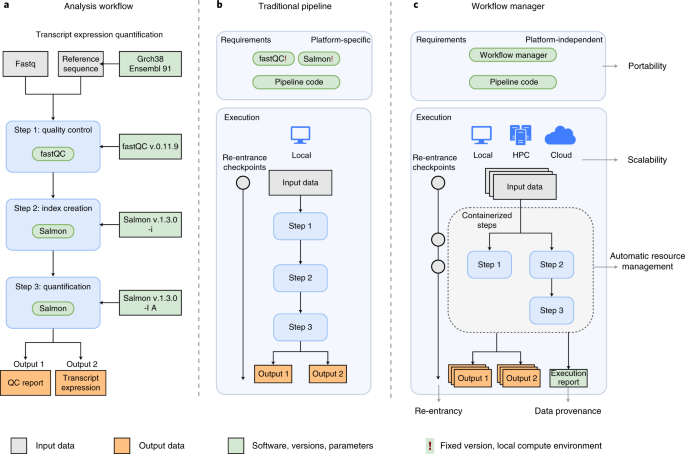 | The rapid growth of high-throughput technologies has transformed biomedical research. With the increasing amount and complexity of data, scalability and reproducibility have become essential not ... www.nature.com |
Workflow managers provide an easy and intuitive way to simplify pipeline development. Here we provide basic proof-of-concept implementations for selected workflow managers. The analysis workflow is based on a small portion of an RNA-seq pipeline, using fastqc for quality controls and salmon for ... github.com |
strand bias and orientation bias – GATK (broadinstitute.org)
"
The read orientation artifact, also known as the orientation bias artifact, arises due to a chemical change in the nucleotide during library prep that results in, for example, G base-paring with A. This kind of artifact has a clear signature (e.g. C to A SNP that occurs predominantly for the middle C in the DNA sequence CCG), and it’s singlestranded in nature. Downstream, this artifact manifests as low allele fraction SNPs whose evidence for the alt allele consists almost entirely F1R2 reads or F2R1 reads. A read pair is F1R2 (forward 1st, reverse 2nd) if the sequence of bases in Read 1 maps to the forward strand of the reference (F1), and the sequence of Read 2 to the reverse strand
of the reference (R2). F2R1 is defined similarly
if someone has read the dragonbioit used guide in illumina, it just mentioned orientation bias, ignore the strand bias.
"
Just realised that other than vcf-compare and bedtools intersect
there's other options
https://github.com/RealTimeGenomics/rtg-tools
https://github.com/Illumina/hap.py
Also there's actually new variant callers ..
Molina-Mora, J.A., Solano-Vargas, M. Set-theory based benchmarking of three different variant callers for targeted sequencing. BMC Bioinformatics 22, 20 (2021). https://doi.org/10.1186/s12859-020-03926-3
Krishnan, V., Utiramerur, S., Ng, Z. et al. Benchmarking workflows to assess performance and suitability of germline variant calling pipelines in clinical diagnostic assays. BMC Bioinformatics 22, 85 (2021). https://doi.org/10.1186/s12859-020-03934-3
. verify_variants.py
Zook, Justin M et al. “An open resource for accurately benchmarking small variant and reference calls.” Nature biotechnology vol. 37,5 (2019): 561-566. doi:10.1038/s41587-019-0074-6
Python library to parse, format, validate, normalize, and map sequence variants. `pip install hgvs`
Had to work with Ion Torrent BAMs for this but I think it's applicable to everything
Needed to run this on unmapped reads so running this first.
After that the next script is fairly simple
Will share the install when I have time. A major hiccup for me was realising not all pre-built db works with Kraken2
This command allows you to see what apps are consuming internet.
ss -p
This software company did something that I didn't expect... putting the variant calling on the phone itself ..
"The variant calling is run directly on the phone, extracting the data from the file on your phone, processed on the phone, and only at the end the VCF file could be shared in the cloud for annotation and reporting by an accredited physician," Ascari said. The physician is necessary to assure that the result is of "diagnostic quality," he added.
I honestly expected CRAM & cloud based calling with encrypted exchange (made feasible with 5G mobile network) of bam reads with an app store like customised reports for what you want to know about your genetics.
Other than security concerns, I don't see why I would want variant calling on the phone though.
Previous posts
Sharing a newly published article where a novel c.682‐2delA variant involving the AG consensus at the 3′ end of BRCA2 intron 8 was detected. The case involved a 33‐year‐old Italian breast cancer patient belonging to a HBOC family (BRCAPro score: 88%) with no other known pathogenic BRCA mutation.
A novel BRCA2 splice variant identified in a young woman - Nicolussi - - Molecular Genetics & Genomic Medicine
I am intrigued that this Genome assembly guide includes mention of SOLID and Ion Torrent ... although not much information is given on how to work on them for genome assembly.
That said, perhaps the SPADES plugin provided with the sequencer solves most of everyone's immediate needs ... Wondering how improve on evaluating the assemblies
IonCRAM: a reference-based compression tool for ion torrent sequence files https://www.ncbi.nlm.nih.gov/pmc/articles/PMC7487613/
IonCRAM, the first reference-based compression tool to compress Ion Torrent BAM files for long term archiving. For the BAM files, IonCRAM could achieve a space saving of about 43%. This space saving is superior to what achieved with the CRAM format by about 8–9%.
Future research for reducing the space consumption of the Ion Torrent BAM files would include the binning of the flow signal and quality values. The idea of binning was initially introduced by Illumina [27] to reduce the space consumption of the quality values. This initiative was immediately followed by intensive research to optimize the binning procedure and address its effect on the downstream analysis, especially on the variant calling step [28–31]. We think that the binning of flow signals and quality data of Ion Torrent would also be successful, provided that the manufacturer contribute to this research. We added an option to IonCRAM for binning the flow signals, in a similar way to the binning method implemented in [26], and measured its effect on compression (Supplementary File 1). We left the step for investigating the effect of this binning on the downstream analysis to further research.
It is worth mentioning that IonCRAM has not been only used for the test data in the paper, it has also been used to compress and backup thousands of files for the Saudi Human Genome Program. IonCRAM is an open source and it is available for free along with the related test data at the tool website http://ioncram.saudigenomeproject.com.
######################################################
# TEMPLATE: A static IP address only when no DHCP
#
#           The profile name is arbitrary. Use "fred"
#           if you want. Not much we can put as
#           default servers, but set them up as
#           you usually would.
######################################################
interface eth0
fallback nodhcp

profile nodhcp
static ip_address=10.0.0.1/8
static routers=10.0.0.1
static domain_name_servers=10.0.0.1
Curious about research priorities and opportunities for human genomics for the next decade? You should read on.
The National Human Genome Research Institute (NHGRI) this week published its “Strategic vision for improving human health at The Forefront of Genomics” in the journal Nature.
The strategic vision culminates with 10 bold predictions for human genomics by 2030. Crafted to be both inspirational and aspirational, the predictions are intended to provoke thoughtful discussions (and even debate) about what might be possible in the coming decade.
I must say that I expected people to store their encrypted genome sequences on smartphones anduse 5G networks to launch on the fly analyses a few years back. Not sure if we will have that by 2030!
it's also a good time to review the 5 years prediction from 2015
Read about gold genomes and platinum genomes...
The 2020 NHGRI Strategic Vision is available online at genome.gov/2020SV.
for f in *\ *; do mv "$f" "${f// /_}"; done
